Chemical powder processing involves several stages, from raw material feeding to final particle classification. At each stage, manufacturers need to maintain stable material flow and control particle size. A suitable vibrating screen can support these tasks by removing oversized particles, separating impurities, and classifying powders and granules.
Chemical materials vary widely in particle size, moisture content, density, flowability, and chemical properties. Therefore, selecting screening equipment requires careful consideration of the entire production process. This article explores how vibrating screens support chemical powder processing, from feeding to particle classification.
1. Material Feeding: Establishing Stable Screening Conditions
Feeding is the first step in a reliable screening process. An uneven feed can cause material accumulation in certain areas of the screen surface. As a result, some particles may receive insufficient contact with the mesh.
In addition, excessive feeding can create a thick material layer. This may restrict particle movement and reduce the effective screening area. A feed rate that is too low, meanwhile, may prevent the equipment from operating within its intended production range.
To improve feeding conditions, manufacturers should consider the material's flowability, bulk density, and required processing capacity. A suitable feeding device can help distribute material more evenly across the screen surface.
For chemical powders with poor flowability, operators should also check whether bridging or material buildup occurs in the feeding section. Proper hopper design and suitable conveying arrangements can help address these issues.
2. Screening Preparation: Understanding Chemical Material Properties
Before selecting a vibrating screen, manufacturers should understand the characteristics of the chemical material.
Particle size and distribution: Chemical powders may contain fine particles, coarse particles, and agglomerates. A particle-size analysis helps identify the required separation range.
Moisture content: Some materials absorb moisture easily. This can cause particles to stick together or form lumps, which may affect screening performance.
Flowability: Fine powders with poor flowability may move unevenly across the screen. Their behavior can influence feeding arrangements and screen selection.
Bulk density: Different materials have different bulk densities. This factor affects material loading and the required equipment configuration.
Chemical compatibility: Some chemicals may react with certain metals or other contact materials. Manufacturers should evaluate corrosion resistance and material compatibility before choosing equipment.
By reviewing these properties, manufacturers can define more suitable screening conditions and avoid selecting equipment based only on nominal particle size.
3. Particle Classification: Selecting the Right Screen Mesh
Mesh selection plays a central role in particle classification. The opening size should match the required separation boundary and the characteristics of the feed material.
For example, a chemical manufacturer may need to remove oversized particles before packaging. Another process may require the separation of fine, medium, and coarse powder fractions.
A mesh opening that is too small may restrict material passage. Conversely, an opening that is too large may allow unwanted particles to pass through.
Moreover, the particle shape and size distribution can affect the actual separation result. Therefore, manufacturers should consider both the target particle size and the proportion of different particle sizes in the feed.
For multi-grade classification, a multi-layer vibrating screen may provide several separation stages within one machine. The number of layers and mesh openings should match the required product fractions and processing conditions.
4. Choosing the Right Vibrating Screen for Chemical Powders
Different vibrating screen designs support different chemical processing applications. The choice depends on the material, required capacity, separation range, and production layout.

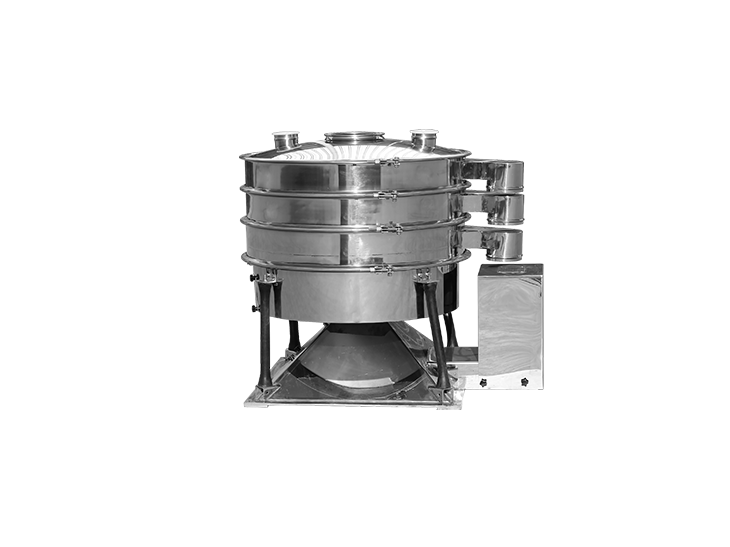
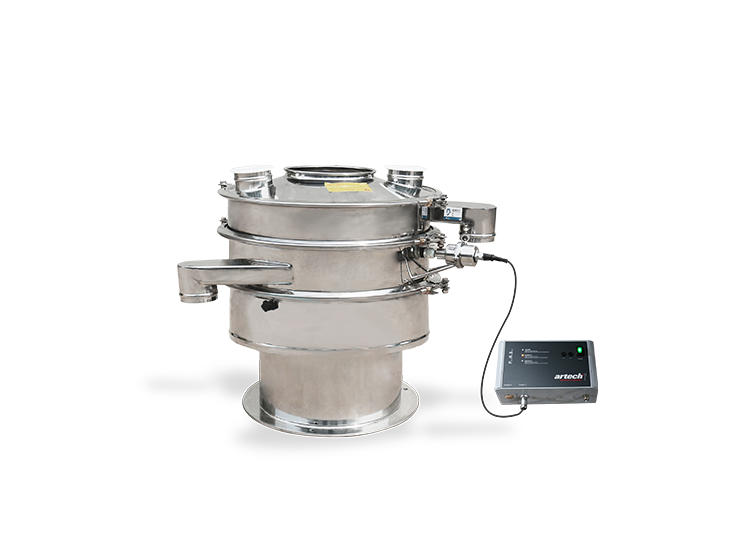
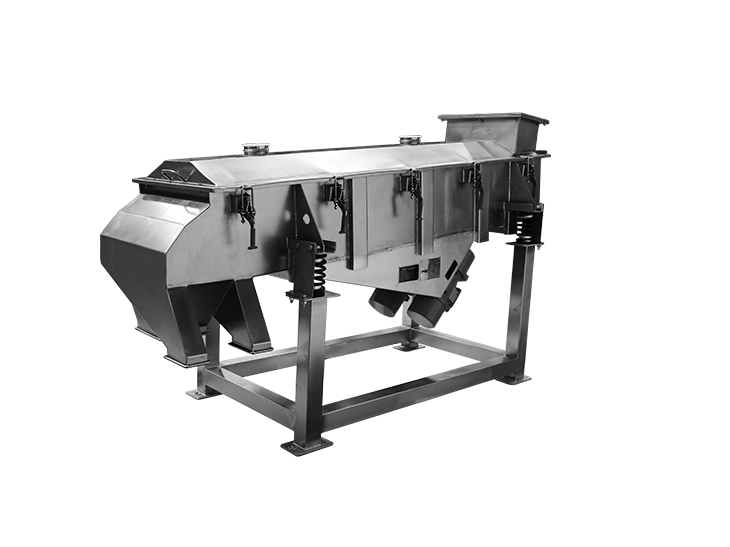
Rotary Vibrating Screen
A rotary vibrating screen is commonly used for powder screening, impurity removal, and particle classification. Its circular motion helps move materials across the screen surface.
It can be considered for chemical powders such as resin powder, pigments, mineral powders, and selected chemical additives. Multi-layer configurations can also support the separation of materials into different size ranges.
Ultrasonic Vibrating Screen
Fine chemical powders may adhere to the mesh or block its openings. This issue can occur with materials that have low flowability or strong particle adhesion.
An ultrasonic vibrating screen applies high-frequency vibration to the screen mesh. This can help reduce particle adhesion and mesh blockage in suitable applications.
It may be worth considering when conventional screening struggles with selected fine powders. However, the actual result depends on material properties, mesh specifications, and operating conditions.
Linear Vibrating Screen
A linear vibrating screen moves materials along a defined screening path. It is commonly considered for continuous screening and classification of selected powders and granules.
For chemical production, it may suit processes that require steady material movement and a particular conveying or production arrangement. The screen area, mesh opening, and feeding conditions should match the application.
Tumbler Screening Machine
A tumbler screening machine uses a screening motion that simulates aspects of manual sieving. It may suit certain applications that require a more gradual screening action.
Manufacturers can evaluate this option when handling selected fine powders or granules. A material test can help determine whether the screening motion and mesh configuration meet the required separation goals.
5. Dust Control and Equipment Sealing
Many chemical powders generate dust during feeding, screening, and discharge. Dust can affect the working environment, material handling, and product recovery.
Therefore, manufacturers should evaluate the sealing structure and dust collection arrangements. Suitable covers, sealed connections, and compatible dust collection systems may help control dust emissions.
The required design depends on the material's properties and the production environment. For combustible dust, manufacturers should also assess the relevant explosion risks and applicable safety requirements. Equipment selection should follow a project-specific safety assessment rather than rely on a general-purpose configuration.
6. Material Compatibility, Cleaning, and Maintenance
Chemical materials may have different requirements for equipment contact surfaces. Some applications need corrosion-resistant materials, while others involve abrasive powders that may increase component wear.
Manufacturers should check the compatibility of screen frames, mesh, seals, and other product-contact components with the chemical being processed. Stainless steel may suit certain applications, but the correct grade depends on the chemical composition and operating conditions.
In addition, regular inspection helps identify mesh damage, loose connections, and material buildup. Operators should follow the equipment manufacturer's instructions for cleaning, maintenance, and replacement of worn parts.
7. From Screening to Production Line Integration
A vibrating screen often works as part of a larger production system. It may connect with feeders, conveyors, mixers, storage hoppers, or packaging equipment.
Therefore, manufacturers should consider the complete material-handling process when selecting a screen. Important factors include installation space, inlet and outlet positions, feed rate, discharge direction, and control requirements.
A well-planned layout can help reduce unnecessary material transfers and support smoother production coordination. However, the final configuration should reflect the actual plant conditions and process requirements.
8. About Gaofu
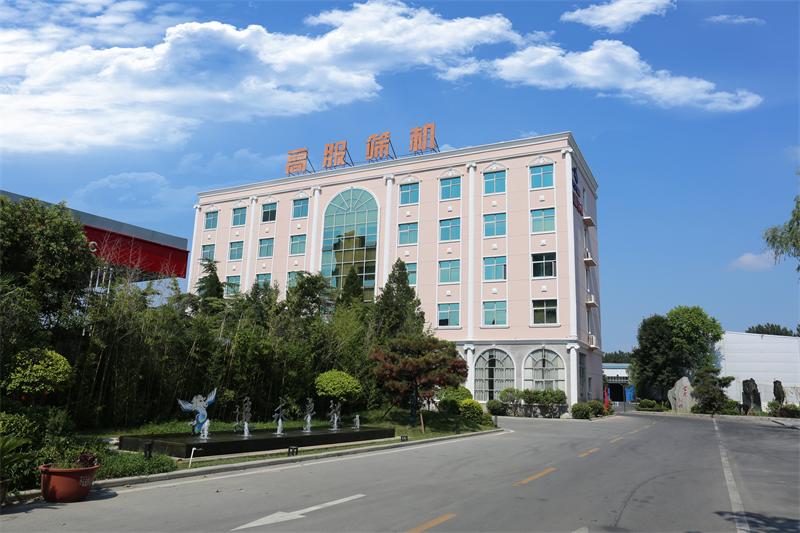
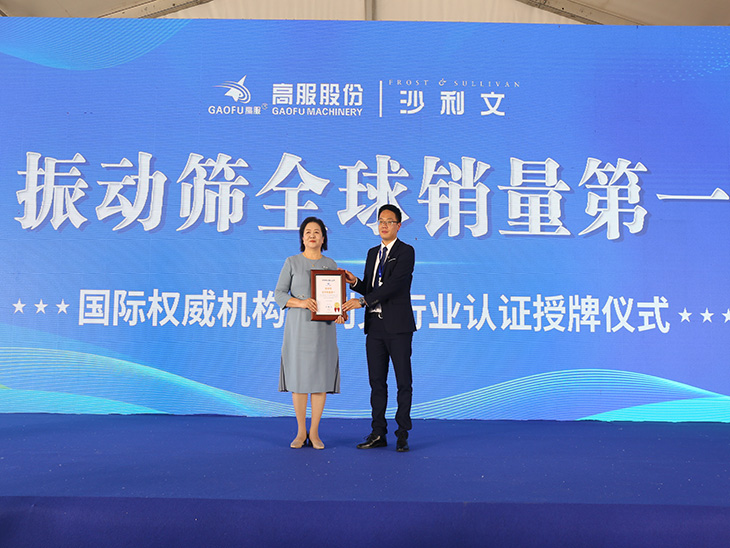
Xinxiang Gaofu Machinery Co., Ltd. has more than 40 years of experience in the research, development, and manufacture of industrial screening equipment. The company provides integrated solutions for screening, conveying, and automated material handling.
Its product range includes rotary vibrating screens, tumbler sieves, ultrasonic vibrating screens, linear vibrating screens, airflow screens, and related conveying, filtration, and coal crushing equipment. These products serve industries such as food, pharmaceuticals, chemicals, metallurgy, building materials, and mining.
Gaofu holds ISO 9001 quality management system certification, while CE marking applies to relevant product series. The company has filed more than 500 patent applications cumulatively and participated in drafting four national standards. Its products reach customers in more than 100 countries and regions, and Gaofu has served over 10,000 customers worldwide.
Conclusion
Chemical powder screening involves more than particle separation. Feeding stability, material properties, mesh selection, dust control, equipment compatibility, and production line integration all influence the screening process.
By evaluating these factors together, manufacturers can identify a vibrating screen configuration that better matches their materials and operating requirements. Gaofu offers rotary, ultrasonic, linear, and tumbler screening solutions for a range of chemical powder and granule applications.
If you are planning a chemical powder screening project, share your material name, target particle size, required processing capacity, and any special corrosion or dust-control requirements with Gaofu. These details can help the team assess a suitable screening solution for your production line.