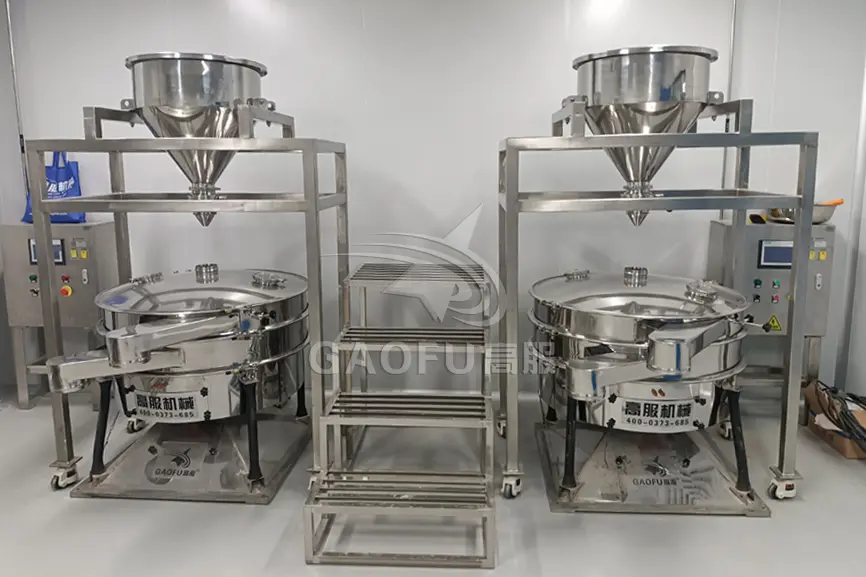
Salt processors often handle more than one grade on the same line. Fine table salt, flaky sea salt, and dense rock crystals each behave differently on a screen. A single fixed motion pattern rarely serves all three well. Gaofu’s tumbler sieve addresses this gap through an adjustable lead angle. This setting changes how salt travels across the mesh. Consequently, one machine adapts to multiple salt types without mechanical modification.
What the lead angle controls
The lead angle defines the angular relationship between the upper and lower eccentric weights on the drive shaft. When operators shift this angle, the tangential component of the tumbling motion changes. This adjustment directly affects the spiral path that salt follows across the screen surface. A larger lead angle produces a faster, flatter spiral. A smaller lead angle creates a slower, tighter path. In practical terms, the lead angle controls how long salt stays on the mesh. Residence time, in turn, shapes both throughput and separation sharpness.
Why residence time matters for salt
Salt screening involves a trade-off. Longer residence time gives each particle more chances to find the correct opening. However, it also reduces capacity. Shorter residence time boosts throughput but can allow near-size particles to exit without proper separation. The lead angle lets operators find the right balance for each salt grade. This flexibility matters because salt types vary widely in shape, density, and surface behavior.
Adjusting for fine table salt
Fine table salt needs careful handling. Its small particles tend to blind the mesh, and its hygroscopic nature makes adhesion more likely. A smaller lead angle slows the spiral path and keeps material on the screen longer. This extended contact gives fine particles repeated opportunities to pass through. Meanwhile, the gentle tumbling motion keeps the material layer loose, which helps resist blinding. For sticky fine salt, operators can pair a reduced lead angle with bouncing ball systems. Food-grade balls tap the underside of the mesh and dislodge trapped particles. Together, these adjustments support stable fine screening without frequent stops.
Adjusting for coarse crystals
Coarse salt crystals require a different approach. They are heavier and need more forward momentum to travel across the deck. A larger lead angle speeds up the spiral path and increases throughput. This setting suits free-flowing industrial salt and coarse rock salt grades. At the same time, the tumbler sieve’s low acceleration protects crystal integrity. Unlike high-frequency screens, it does not throw particles into the air. Crystals roll and glide instead. As a result, breakage and fines generation stay lower, even at higher flow rates.
Adjusting for changing conditions
Salt moisture does not stay constant. Ambient humidity, storage conditions, and washdown practices all shift the material’s behavior. Operators can respond by changing the lead angle alongside rotational speed and eccentricity. For damp, sticky salt, a steeper angle keeps material moving and reduces the risk of compaction on the mesh. For dry, free-flowing salt, a faster setting supports higher capacity. This adjustability helps a single tumbler sieve remain productive across seasonal and batch-to-batch variation.
Stainless steel and cleanability support the adjustment
The lead angle adjustment works within a machine built for corrosive salt environments. Product-contact parts use SUS304 or SUS316L stainless steel. SUS316L offers greater resistance to chloride pitting and often suits sea salt or high-humidity plants. Internal surfaces receive a polished finish to reduce salt adhesion. Quick-release clamps allow tool-free access to the screening area. When operators change the lead angle for a new grade, they can also inspect and clean the mesh without delay. The enclosed housing and food-grade gaskets contain dust and limit moisture ingress. These features keep the adjustment practical in day-to-day operation.
Conclusion
The lead angle is a small setting with a large effect on salt screening. It decides how long salt stays on the mesh, and therefore how well fine particles separate and how fast coarse crystals move. Gaofu’s tumbler sieve makes this adjustment accessible, so processors can tune one machine to multiple salt grades and changing moisture conditions. If your line handles edible salt, sea salt, rock salt, or industrial salt, contact our sales engineering team. Share your salt types, moisture range, and capacity targets. We can discuss a suitable tumbler sieve configuration or arrange a material test.
About Gaofu
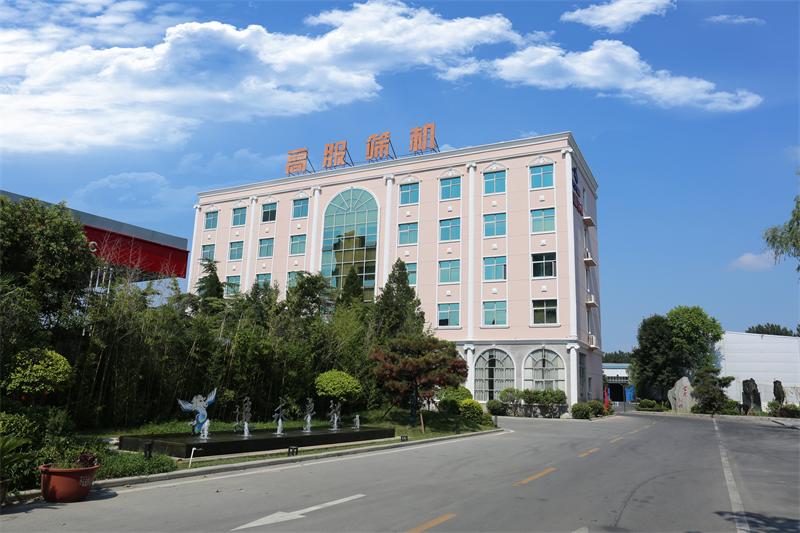
Xinxiang Gaofu Machinery Co., Ltd. has more than 40 years of experience in the research, development, and manufacture of industrial screening equipment, providing integrated solutions for screening, conveying, and automated material handling. Its product range covers rotary vibrating screens, tumbler sieves, ultrasonic vibrating screens, linear vibrating screens, airflow screens, and related conveying, filtration, and coal crushing equipment. These products are used in food, pharmaceutical, chemical, metallurgy, building materials, mining, and other industries.
The company holds ISO 9001 quality management system certification, and CE marking is applied to applicable product series. Gaofu has filed more than 500 patent applications cumulatively and has participated in drafting four national standards. Its products are sold in China and exported to more than 100 countries and regions, including the United States, Australia, Russia, the United Kingdom, Spain, Germany, the Netherlands, Poland, the Philippines, Thailand, Indonesia, and Singapore. Gaofu has served more than 10,000 customers worldwide.