Salt screening presents unique challenges. The material varies from fine, free-flowing vacuum salt to damp, sticky solar salt and hard, abrasive rock salt. Selecting the right vibrating screen for salt directly affects product quality, throughput, and maintenance costs. Among the available technologies, two distinct approaches dominate: traditional vibrating screens that use high-frequency, linear or circular motion, and tumbler sieves that employ a gentle, three-dimensional tumbling action. At Gaofu Machinery, we design tumbler sieves specifically for salt applications. This article compares these two screening methods and explains why the tumbler sieve motion offers practical advantages for many salt processors.
How traditional vibrating screens work
Traditional vibrating screens, including rotary vibrating sieves and linear vibrating screens, generate motion through eccentric weights mounted on a motor shaft. In a rotary vibrating sieve, the upper weight creates horizontal vibration while the lower weight produces an inclined force. Together, they generate a three-dimensional motion that throws particles into the air and moves them across the screen surface. Linear vibrating screens use two counter-rotating motors to produce a straight-line throwing action.
These methods work adequately for many applications. They provide reasonable throughput and can handle a variety of materials. However, the high-frequency throwing action has inherent limitations when screening salt. Particles experience impact forces as they land on the mesh. This can break fragile crystals into unwanted fines. Furthermore, the rapid vibration can compact damp salt against the screen, causing blinding. Consequently, operators must frequently stop production to clean the mesh, reducing overall efficiency.
How tumbler sieve motion works
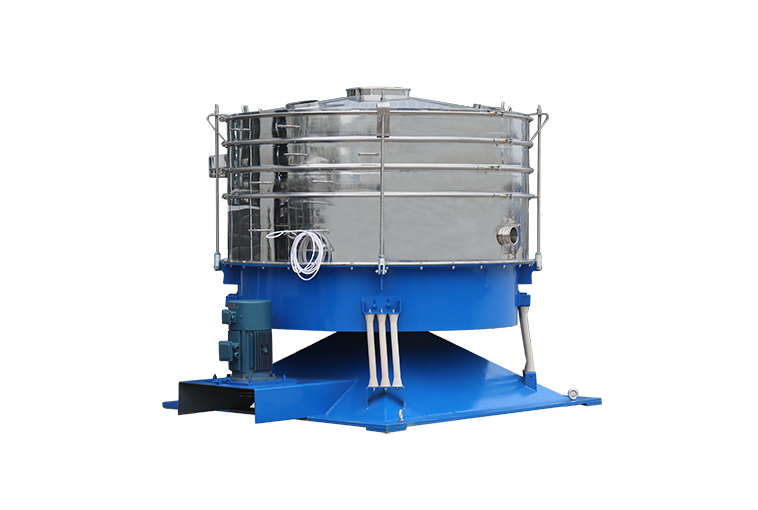
A tumbler sieve operates on a fundamentally different principle. Instead of throwing material into the air, it generates a three-dimensional tumbling motion that closely mimics hand sieving. The screen deck moves in a smooth, orbital pattern. Salt spreads evenly across the entire mesh surface in a thin layer. Particles roll and glide gently, finding the correct openings without impact or bounce. This extended, gentle contact with the screen gives each particle multiple opportunities to pass through the correct mesh opening. As a result, separation accuracy improves significantly compared to traditional throwing methods.
The tumbler motion comes from a drive system that combines an eccentric shaft and a gearing mechanism. Operators can adjust the lead angle, rotational speed, and eccentricity to fine-tune the screening pattern for specific salt types. For example, fragile sea salt flakes benefit from a slow, gentle advance. Dry, free-flowing industrial salt screens effectively at higher speeds. Therefore, a single tumbler sieve adapts to a wide range of salt products without mechanical modifications.
Comparing separation accuracy
The most significant difference between tumbler sieves and traditional vibrating screens lies in separation sharpness. Traditional screens rely on high-frequency vibration to move material across the mesh. While this works for coarse separations, fine screening below 500 microns becomes challenging. Near-size particles bounce unpredictably, reducing the probability that they will find the correct opening. Tumbler sieves, in contrast, keep material in constant contact with the screen. Particles roll and slide, which gives undersized material more time to pass through. Consequently, tumbler sieves achieve sharper separations, producing a narrower particle size distribution with fewer misplaced particles. For salt processors who need precise grading into multiple fractions, this accuracy translates directly into higher product value and fewer customer rejects.
Comparing particle integrity
Salt crystal integrity matters greatly for certain markets. Gourmet sea salt flakes, for instance, command premium prices based on their visual appearance and crystal shape. Traditional vibrating screens often damage these delicate structures. The repeated impact of particles hitting the mesh breaks crystals into smaller, irregular pieces. In addition, the throwing action generates dust, which represents both product loss and a corrosion risk. Tumbler sieves handle particles far more gently. The rolling motion minimizes crystal breakage and dust generation. Furthermore, enclosed operation contains any dust that does form, protecting the plant environment. For this reason, salt producers who sell specialty or high-value salts often prefer tumbler sieve technology.
Comparing anti-blinding performance
Screen blinding is a persistent problem when screening damp or sticky salt. Solar salt, in particular, often retains residual moisture that causes particles to adhere to the mesh. Traditional vibrating screens tend to compact this sticky material against the screen surface. The high-frequency motion can actually force particles into the mesh openings, making blinding worse. Tumbler sieves keep the material layer loose and fluid. The orbital motion prevents compaction. Particles continuously roll and shift, which stops them from lodging in the openings. Additionally, Gaofu can equip tumbler sieves with bouncing ball cleaning systems or ultrasonic transducers for extra anti-blinding capability. As a result, tumbler sieves maintain consistent screening efficiency over longer production runs, with fewer stoppages for cleaning.
Comparing corrosion resistance and build quality
Both traditional vibrating screens and tumbler sieves must resist salt's corrosive nature. Gaofu builds both machine types with product-contact parts in SUS304 or SUS316L stainless steel, with polished internal surfaces and food-grade silicone gaskets. However, the mechanical design of tumbler sieves offers additional protection. The drive system uses a single motor and robust gearing, with bearings positioned away from the product zone. There are no high-frequency vibrating components that fatigue and crack under continuous stress. Therefore, tumbler sieves often provide longer service life and lower maintenance requirements in harsh salt environments.
Comparing throughput and scalability
Traditional vibrating screens generally offer higher throughput for very coarse separations above 2 mm. Their high-speed throwing action moves large volumes quickly. However, for fine salt grading below 1 mm, tumbler sieves often match or exceed the throughput of traditional machines while delivering superior separation quality. Gaofu offers tumbler sieves in various diameters and motor sizes to match different production volumes, from small specialty salt works to large industrial operations. The adjustable motion parameters also allow operators to balance throughput against accuracy based on current production needs.
Conclusion
The choice between a tumbler sieve and a traditional vibrating screen for salt depends on your specific priorities. If you value throughput above all else for coarse separations, a traditional vibrating screen may serve your needs. However, if you require precise, gentle grading with minimal crystal breakage, reliable anti-blinding performance, and lower maintenance demands, a tumbler sieve offers clear, practical advantages. Gaofu Machinery designs and builds both technologies, and we encourage salt processors to send material samples for laboratory testing. A trial run with your actual salt can demonstrate the differences in separation quality, throughput, and product handling, helping you make an informed, practical decision for your operation.
To learn more about Gaofu tumbler sieves for salt or to arrange a material test, please contact our sales engineering team.
About Gaofu
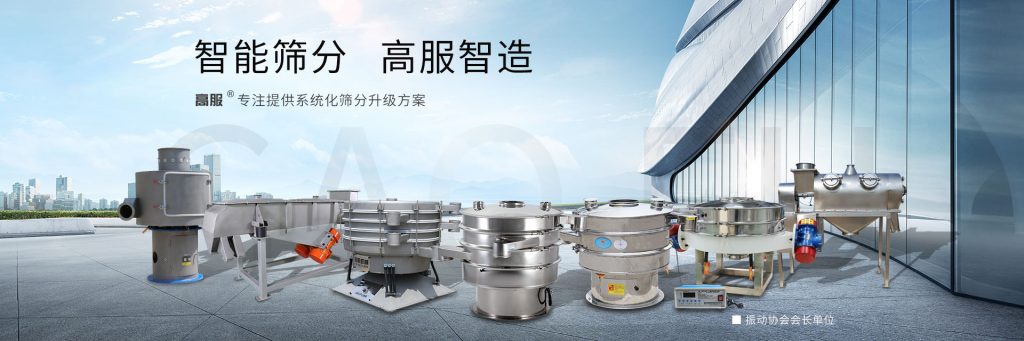
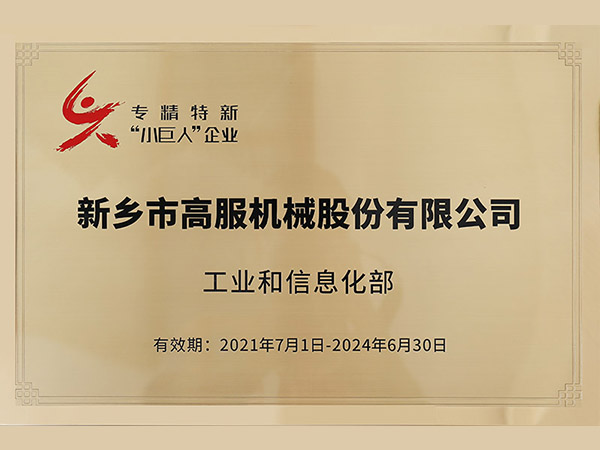
The predecessor of Xinxiang Gaofu Machinery Co., Ltd. started in the 1980s. Over more than 40 years, the company has grown into a "National-level Specialized, Refined, Differential, and Innovative (SRDI) 'Little Giant' Enterprise." It also holds the titles of "National-level Green Factory," "National-level High-tech Enterprise," and "National-level Intellectual Property Advantage Enterprise." Furthermore, the company serves as the "Chairing Unit of the Vibration Association."
The company hosts the "Henan Industrial Design Center," the "Henan Intelligent Online Screening System Engineering Technology Research Center," and the "Xinxiang Precision Screening Engineering Technology Research Center." Gaofu has secured over 500 patents covering inventions, utility models, and designs. It received a "Science and Technology Achievement Award" from the Ministry of Industry and Information Technology. It also helped draft four "National Standards."
Gaofu's product portfolio spans multiple series and hundreds of varieties, including vibrating screening equipment, conveying equipment, coal crushing equipment, filtration equipment, and automated material handling systems. Key products include vibrating screens, screening machines, vibrating separators, rotary vibrating sieves, ultrasonic vibrating sieves, linear screens, airflow screens, tumbler screens, roller screens, dewatering screens, grizzly screens, vacuum loaders, dust-free feeding stations, bulk bag (FIBC) feeding stations, material supply systems, automatic powder supply systems, automatic slag-discharging filters, leaf filters, bleaching earth filters, toothed roll crushers, and coal crushers. These products serve industries such as food, pharmaceuticals, chemicals, metallurgy, building materials, mining, thermal power, and environmental protection. They have earned the trust and acclaim of over 10,000 customers worldwide.
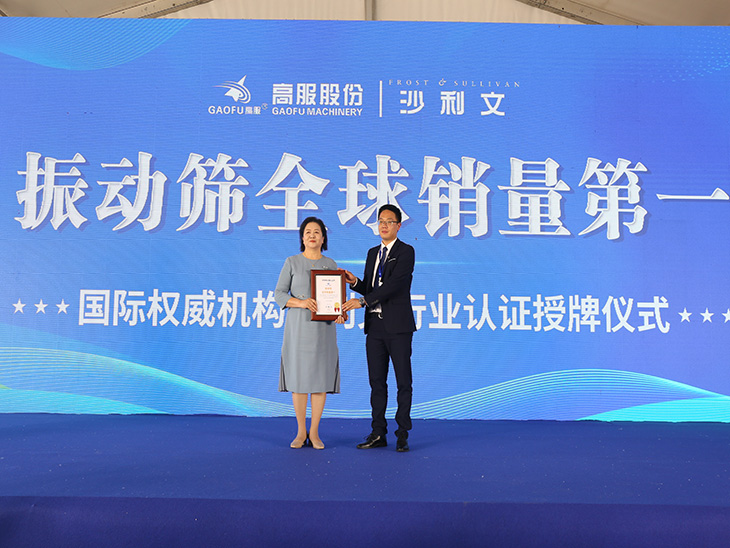
Gaofu products sell well across the Greater China region. The company also exports them to more than 100 countries and regions, including Russia, Canada, the USA, New Zealand, Japan, Brazil, and South Africa. The company upholds the mission of "enhancing material quality and efficiency to meet customer needs." It builds harmonious, mutually beneficial partnerships with its clients. Gaofu has become a supplier to numerous Fortune Global 500 companies, including CNPC, Sinopec, Sinochem, China Resources, Sinopharm, COFCO, CNBM, CASC, and Jinchuan Group. In May 2024, Frost & Sullivan, an international consulting firm, issued a market position confirmation certificate, recognizing Gaofu as the global leader in vibrating screen sales by volume for 2023.