Herbal medicine powders are widely used in traditional medicine products, herbal extracts, health-related ingredients, and various botanical preparations. During production, manufacturers process dried roots, leaves, flowers, stems, and other plant materials into powders or granules. These materials often have different particle sizes, shapes, and flow characteristics.
As a result, screening plays an important role in herbal powder processing. A suitable vibrating sieve can help separate coarse particles, classify powder, and remove oversized materials after grinding. GAOFU rotary vibrating screens offer an equipment option for these applications, with configurations based on material properties and production requirements.
1. Why Screening Matters in Herbal Medicine Powder Processing
Herbal materials have complex physical characteristics. Unlike some uniform industrial powders, plant-based materials may contain fibers, irregular particles, and fragments with different shapes. These characteristics can affect how materials move across a screen surface.
For example, dried roots may produce fibrous particles after grinding. Leaf powders can contain fine particles mixed with larger fragments. Meanwhile, some botanical materials absorb moisture and form agglomerates during storage or handling.
Screening helps manufacturers manage these differences. It can separate particles according to the selected mesh opening and support more consistent powder preparation before blending, extraction, packaging, or other processing stages.
Furthermore, screening can help remove oversized particles that remain after grinding. However, a vibrating sieve does not replace the grinding process. It separates material according to screen openings rather than reducing particle size through crushing.
2. Common Herbal Powders That Require Screening
Herbal medicine production involves a wide range of plant materials. Each material may require a different screening approach.
Root and rhizome powders: Materials such as ginger, turmeric, and other dried roots may produce fibrous or irregular particles. Screening can help separate coarse fragments from finer powder after grinding.
Leaf powders: Dried leaves often produce lightweight particles with varied shapes. Their flow behavior may require attention to feeding uniformity and screen selection.
Flower and botanical powders: Flower-based materials and other botanical ingredients can contain particles with different densities and structures. A suitable screening arrangement can help classify these materials.
Herbal extract powders: Extract powders may have different flow characteristics depending on the extraction and drying processes. Some products may show a tendency to absorb moisture or form lumps. Therefore, manufacturers should evaluate representative samples before choosing a screening configuration.
Mixed herbal powders: Some production lines handle blends of multiple plant ingredients. In these cases, buyers should consider the particle characteristics of each component and define the required screening result.
3. How a Rotary Vibrating Screen Works with Herbal Powders
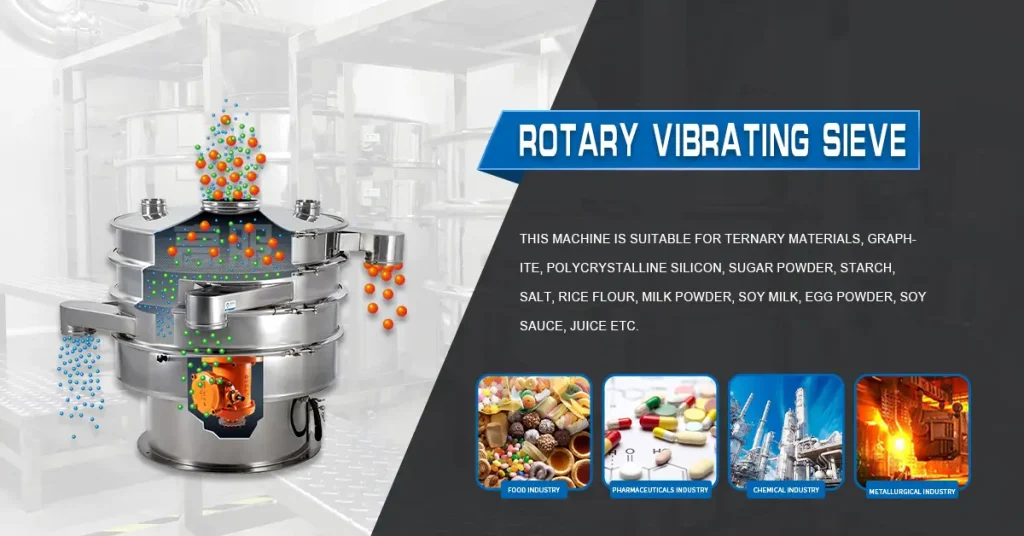
A rotary vibrating screen uses a vertical motor and eccentric weights to generate three-dimensional vibration. This movement helps spread material across the screen surface and guides it toward the discharge outlet.
During screening, particles smaller than the selected mesh openings can pass through the screen. Larger particles remain on the mesh and move toward a separate discharge outlet.
For herbal powders, this process can support coarse particle removal and size classification. In addition, a multi-layer rotary vibrating screen can separate material into several fractions when the production process requires multiple size ranges.
However, herbal powders can behave differently from free-flowing materials. Fibrous particles may move irregularly, while moisture can encourage powder adhesion or agglomeration. Therefore, screening results depend on the material, mesh opening, feed rate, screen area, and operating conditions.
4. Key Factors When Selecting a Vibrating Sieve
Choosing a vibrating sieve for herbal medicine powder requires an understanding of the material and the desired result.
Particle size distribution: Identify the approximate size range after grinding. Also, determine whether the process needs coarse particle removal or classification into several fractions.
Fiber content and particle shape: Some herbal powders contain long or irregular fibers. These characteristics may influence mesh selection and material movement across the screen.
Moisture and flowability: Moisture can increase adhesion and encourage lump formation. Therefore, manufacturers should evaluate material conditions during actual production.
Mesh opening: The selected opening should match the screening objective. However, mesh size does not guarantee an exact final particle size because particle shape and operating conditions also affect separation.
Screen layers and capacity: Different production targets may require different screen diameters or layer arrangements. Buyers should provide realistic throughput requirements and discuss them with the equipment supplier.
Product-contact materials: Herbal powder manufacturers should confirm suitable contact materials and surface finishes. Stainless steel may suit many applications, but the required grade and cleaning arrangements depend on the product and facility requirements.
5. Reducing Mesh Blockage During Fine Powder Screening
Fine herbal powders may stick to the mesh or accumulate around screen openings. Fibrous particles and moisture can also affect screening continuity.
Several measures may help address these challenges. First, manufacturers should select a suitable mesh structure and avoid feeding excessive material onto the screen. Next, they should check whether the feeding system distributes powder evenly across the screening surface.
For certain fine powders, an ultrasonic vibrating screen may be worth evaluating. It applies high-frequency vibration to the screen mesh and can help reduce mesh blockage in suitable applications.
Nevertheless, ultrasonic screening does not eliminate blockage under every condition. Material tests can help determine whether this technology offers practical benefits for a particular herbal powder.
6. Hygiene, Cleaning, and Production Line Integration
Herbal powder processing requires attention to cleaning and material handling. Residual powder from previous batches may affect subsequent production, especially when manufacturers process different botanical ingredients.
Therefore, buyers should check whether operators can access product-contact areas for inspection and cleaning. They should also confirm the cleaning method, screen replacement procedure, and relevant maintenance requirements.
In addition, the vibrating sieve should fit the wider production line. A typical arrangement may include a feeding hopper, grinding equipment, vibrating screen, conveying system, and storage or packaging equipment.
Dust collection also deserves attention. Fine herbal powders can become airborne during feeding and discharge. Manufacturers should assess suitable covers, sealing, ventilation, and dust collection according to the material and facility conditions.
Where combustible dust risks exist, the project requires a specific risk assessment and appropriate safety measures. Buyers should confirm any required explosion protection through the actual equipment specification rather than assume standard equipment provides it.
7. About GAOFU

Xinxiang Gaofu Machinery Co., Ltd. has more than 40 years of experience in the research, development, and manufacture of industrial screening equipment. The company provides integrated solutions for screening, conveying, and automated material handling.
Its product range includes rotary vibrating screens, tumbler sieves, ultrasonic vibrating screens, linear vibrating screens, airflow screens, and related conveying, filtration, and coal crushing equipment. These products serve customers in food, pharmaceutical, chemical, metallurgy, building materials, mining, and other industries.
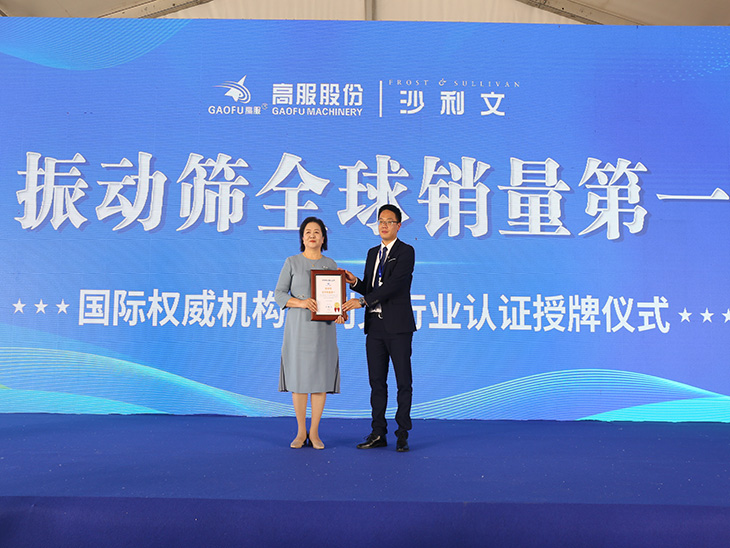
GAOFU holds ISO 9001 quality management system certification, and CE marking applies to relevant product series. The company has filed more than 500 patent applications cumulatively and participated in drafting four national standards.
Its products reach customers in China and more than 100 countries and regions, including the United States, Australia, Russia, the United Kingdom, Spain, Germany, the Netherlands, Poland, the Philippines, Thailand, Indonesia, and Singapore. GAOFU has served more than 10,000 customers worldwide.
For herbal medicine powder processing, GAOFU can discuss rotary vibrating screen configurations according to material characteristics, screening targets, and production requirements.
Conclusion
Herbal medicine powders often contain particles with different sizes, shapes, and flow characteristics. A suitable rotary vibrating screen can support coarse particle removal and powder classification after grinding.
However, the right configuration depends on the botanical material, fiber content, moisture, target particle range, and production conditions. By preparing these details before purchasing equipment, manufacturers can work with suppliers to identify a screening solution that fits their process.
Are you looking for a vibrating sieve for herbal powder processing? Share your material name, target particle size, required capacity, and any special cleaning or dust control requirements with the GAOFU team. These details can help us discuss suitable equipment options for your application.