In any flour milling or food processing operation, sieving is a fundamental step. It removes bran, foreign seeds, insects, and oversized particles. It also aerates flour for consistent baking performance. However, not all sieving equipment works the same way. An industrial flour sifter built on vibrating sieve technology differs significantly from simple standard sieves. Understanding these differences helps you choose the right equipment. It needs to match your production volume, food safety requirements, and quality targets.
At Gaofu Machinery, we manufacture vibrating sieves for flour mills and bakeries worldwide. Specifically, here, we compare an industrial flour sifter with standard sieving methods. This clarifies what each offers and where the practical limits lie.
What counts as a standard sieve?
A standard sieve can be a hand-operated screen or a simple flat-bed sifter. It could also be a small electrically driven sieve used in low-capacity settings. These devices often rely on a single plane of motion. For instance, this may be vertical oscillation or a basic circular shake. Their screen area is usually limited. Operators must frequently stop the machine to remove retained material or clean a blinded mesh.
Standard sieves work adequately for very small batches. They also suit a preliminary check in a laboratory. However, when a flour mill or industrial bakery runs continuously, a standard sieve quickly becomes a bottleneck. Feed rates are low. Screen changes are time-consuming. The open design can allow flour dust to spread into the workspace.
How an industrial flour sifter (vibrating sieve) works differently
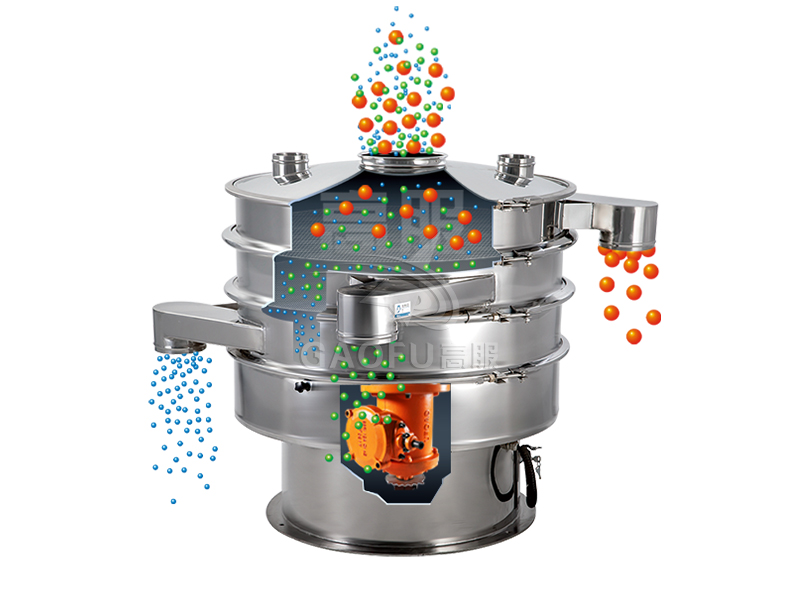
An industrial flour sifter like the Gaofu rotary vibrating sieve generates three-dimensional motion. It uses eccentric weights on the upper and lower ends of the motor shaft. This produces a gentle, spiraling action. It spreads flour evenly across the entire screen surface. Particles roll and glide, finding openings with minimal friction. The three-dimensional motion gives even near-size particles a better chance of passing through. As a result, this improves separation sharpness without breaking fragile flour particles.
The vibrating sieve can be configured with multiple stacked decks. This allows one industrial flour sifter to separate flour into several fractions simultaneously. This setup removes coarse material on the top deck, collects on-spec flour on a middle deck, and catches fine dust at the bottom. In contrast, standard sieves rarely offer this multi-fraction capability in a single pass.
Screening capacity and throughput
The most obvious difference is throughput. A hand-operated or small flat sieve may process a few dozen kilograms per hour. In contrast, a Gaofu vibrating sieve for flour can handle several tons per hour. This depends on the model diameter and mesh configuration. For a flour mill processing 10, 20, or more tons daily, only an industrial flour sifter can keep pace. It matches upstream milling and downstream packing lines.
The higher throughput does not come from simply increasing motor power. It results from a larger screen area and the efficient three-dimensional motion. It also comes from the ability to run continuously without frequent stops. An industrial flour sifter uses the full screen surface. Standard sieves often concentrate material in the center. They underuse the available mesh.
Screening accuracy and consistency
Flour product specifications often call for a specific granulation range. Manufacturers measure this in microns or mesh numbers. An industrial flour sifter with properly tensioned stainless steel mesh delivers consistent results. This holds true across long production runs. Gaofu vibrating sieves use mesh tensioning systems that keep the screen flat and tight. The opening size remains stable. Standard sieves, especially those with hand-stretched mesh, can lose tension quickly. This leads to inaccurate separation and potential quality drift.
Furthermore, an industrial flour sifter can be tuned. An operator adjusts the eccentric weights. This changes the amplitude and phase angle of the vibration. The machine can then handle flours with different densities, moisture contents, or flow characteristics. A standard sieve usually has fixed or very limited adjustment. You must accept whatever sieving behavior the machine delivers out of the box.
Hygiene and food safety
Flour is a food ingredient. Sieving equipment must meet strict hygiene standards. An industrial flour sifter from Gaofu uses SUS304 or SUS316L stainless steel for product-contact parts. Internal surfaces are polished to a smooth finish. This prevents flour buildup and simplifies cleaning. Quick-release clamps allow operators to open the machine without tools. This supports routine inspection, dry brushing, or wet washing. The enclosed design keeps flour dust contained. It protects the workspace and reduces the risk of cross-contamination.
Standard sieves, especially open-frame designs, expose flour to the surrounding environment. This makes it harder to control humidity, pest access, or airborne contaminants. In a commercial bakery or flour mill, an industrial flour sifter offers clear advantages. Its enclosed, easy-to-clean construction supports HACCP or similar food safety programs.
Durability and maintenance
Continuous operation places stress on sieving equipment. An industrial flour sifter uses robust bearings, reinforced frames, and high-quality gaskets. These components are designed for thousands of hours of service. At Gaofu, we keep common spare parts in stock. This includes mesh screens, gaskets, and clamps. We also offer remote or on-site support to help customers maintain their vibrating sieves. Standard sieves are built to a lighter specification. They generally wear out faster. Moreover, they may lack the spare parts support needed to keep a production line running.
Which sieve is right for your flour operation?
A standard sieve can be useful for small-scale testing, R&D, or micro-batch production. However, once a flour business scales beyond a few hundred kilograms per hour, an industrial flour sifter becomes necessary. It maintains throughput, accuracy, and food safety standards.
The Gaofu vibrating sieve provides the throughput, hygiene, and adjustability that industrial flour mills and large bakeries need. It handles a wide range of flour types. For example, this spans from soft wheat flour to durum semolina. It can be integrated directly after milling, before storage, or immediately ahead of packing or dough mixing.
To see how a Gaofu industrial flour sifter can fit your flour processing line, contact our sales engineering team. We invite you to send flour samples for testing at our laboratory. There we can demonstrate separation performance on your actual material.
About Gaofu
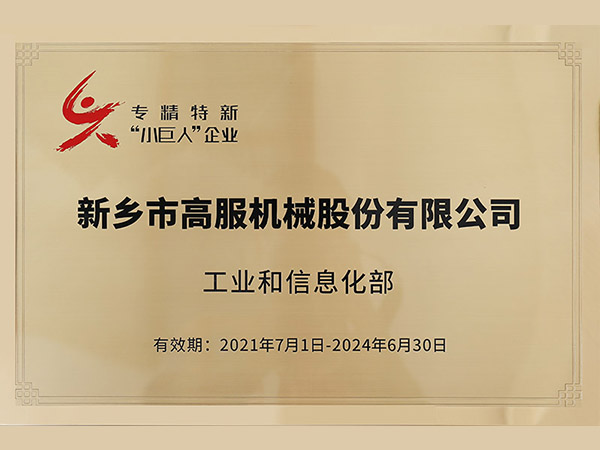
The predecessor of Xinxiang Gaofu Machinery Co., Ltd. was established in the 1980s. Over more than 40 years of development, the company has evolved into a "National-level Specialized, Refined, Differential, and Innovative (SRDI) 'Little Giant' Enterprise," a "National-level Green Factory," a "National-level High-tech Enterprise," and a "National-level Intellectual Property Advantage Enterprise," while also serving as the "Chairing Unit of the Vibration Association." It hosts the "Henan Industrial Design Center," the "Henan Intelligent Online Screening System Engineering Technology Research Center," and the "Xinxiang Precision Screening Engineering Technology Research Center." The company has successfully secured over 500 patents—covering inventions, utility models, and designs—received a "Science and Technology Achievement Award" from the Ministry of Industry and Information Technology, and participated in drafting four "National Standards."
Gaofu’s product portfolio spans multiple series and hundreds of varieties, including vibrating screening equipment, conveying equipment, coal crushing equipment, filtration equipment, and automated material handling systems. Key products include vibrating screens, rotary vibrating screens, ultrasonic vibrating screens, linear screens, airflow screens, tumbler screens, roller screens, dewatering screens, grizzly screens, vacuum loaders, dust-free feeding stations, bulk bag (FIBC) feeding stations, material supply systems, automatic powder supply systems, automatic slag-discharging filters, leaf filters, bleaching earth filters, toothed roll crushers, and coal crushers. These products are widely used across industries such as food, pharmaceuticals, chemicals, metallurgy, building materials, mining, thermal power, and environmental protection, earning the trust and acclaim of over 10,000 customers worldwide.
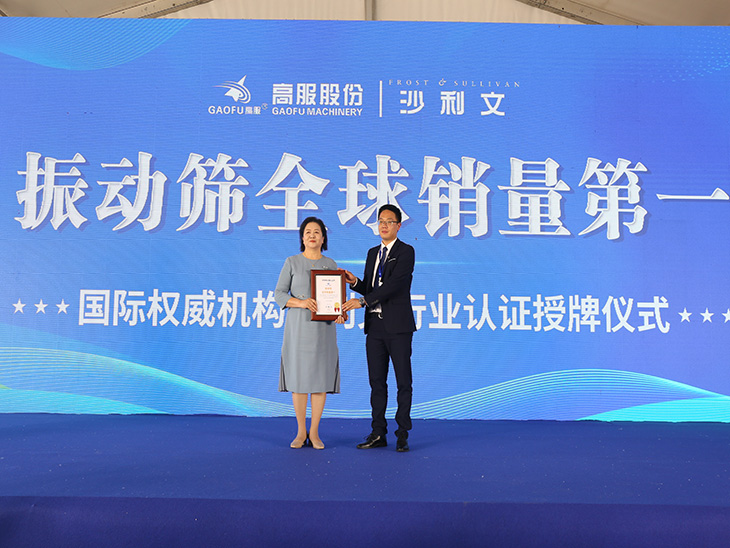
Gaofu products are widely trusted in the Greater China region and are also exported to more than 100 countries and regions, including Russia, Canada, the USA, New Zealand, Japan, Brazil, and South Africa. Upholding the mission of "enhancing material quality and efficiency to meet customer needs," the company fosters harmonious, mutually beneficial partnerships with its clients. Gaofu has become a supplier to numerous Fortune Global 500 companies, including CNPC, Sinopec, Sinochem, China Resources, Sinopharm, COFCO, CNBM, CASC, and Jinchuan Group. In May 2024, Frost & Sullivan, an international consulting firm, issued a market position confirmation certificate, recognizing Gaofu as the global leader in vibrating screen sales by volume for 2023.