In salt processing, achieving a consistent particle size is essential for product quality, dissolving performance, and customer satisfaction. Whether producing fine table salt, coarse sea salt, or industrial-grade crystals, the screening stage largely determines the final grade. A salt sieving machine built around rotary vibrating sieve technology helps processors achieve accurate separations while handling the unique challenges of salt: its corrosiveness, its varied crystal shapes, and its tendency to absorb moisture. At Gaofu Machinery, we design rotary vibrating sieves specifically for salt applications. Understanding how this equipment works can help you get the most from your screening operation.
How a rotary vibrating sieve generates its screening motion
The heart of the rotary vibrating sieve is a vertically mounted motor with adjustable eccentric weights on the upper and lower ends of the motor shaft. When the motor runs, these weights generate centrifugal force. The upper weight produces a horizontal vibration that spreads the salt evenly across the screen surface. The lower weight creates an inclined, three-dimensional motion that moves the particles forward in a controlled spiral path.
Together, these two forces create a gentle but highly effective screening action. Salt crystals roll and glide over the mesh rather than bouncing or being thrown. This preserves their shape and prevents them from breaking into unwanted fines. Because the motion is three-dimensional, every crystal gets multiple chances to find the correct mesh opening. The result is a sharp separation between particle sizes—even when the difference is only a few hundred microns.
Operators can adjust the eccentric weights independently. Changing the angle of the lower weight, for example, alters the phase angle and the speed at which material travels across the screen. This lets you fine-tune the machine’s behavior for different salt types—from fragile sea salt flakes that need a slow, gentle advance to free-flowing vacuum salt that can be screened at higher throughput.
Why this motion works well for salt
Salt is a challenging material to screen. It is often humid, sticky, or dusty, depending on its source and processing history. Standard sieving methods that rely on a simple vertical shake or circular motion can easily blind the screen, forcing operators to stop frequently for cleaning. The rotary vibrating sieve’s three-dimensional movement keeps the material layer loose and fluid, which helps the screen remain clear. Even fine, damp solar salt can pass through with minimal clogging.
Moreover, the gentle action reduces dust generation. Salt dust is not only a product loss but also a corrosion risk for surrounding equipment and a respiratory concern for workers. A rotary vibrating sieve that rolls the salt along a contained path generates far less airborne dust than impact-based or aggressive vibrating systems. The enclosed design also keeps any dust safely inside the machine.
Key components and their role in salt sieving
A typical rotary vibrating sieve for salt consists of several key elements:
- Screen decks and mesh: The machine can be configured with one to four stacked screens. Each deck holds a woven stainless steel mesh tensioned across a frame. Mesh openings range from coarse sizes (several millimeters) down to fine micron grades. For salt, proper tensioning is critical because a loose mesh will quickly lose its separation accuracy and can tear under load.
- Discharge outlets: Multiple outlets direct the different size fractions to their respective bins or conveyors. Oversized salt crystals exit from one spout; on-spec product exits from another; fine dust, if present, exits from the lowest deck. This multi-fraction capability allows a single salt sieving machine to replace several separate screens.
- Hygienic construction: Salt is highly corrosive, especially under humid plant conditions. Gaofu builds its rotary vibrating sieves with product-contact parts in SUS304 or SUS316L stainless steel. Internal surfaces are polished to a smooth finish, reducing areas where salt can accumulate. Quick-release clamps let operators open the machine without tools for inspection, cleaning, or mesh changes. Food-grade silicone gaskets provide a reliable seal.
- Motor and base: A durable casing houses the vertical motor. The entire screen assembly sits on a set of springs that isolate vibration from the plant floor, keeping noise levels low and reducing structural stress.
The screening process step by step
- Feeding: Salt enters the sieve through a central inlet on the top cover. A distributor cone or plate spreads the material outward onto the center of the top screen.
- Stratification and separation: The three-dimensional motion immediately spreads the salt into an even layer. Smaller particles move downward through the material bed and contact the screen surface. They pass through the mesh openings. Larger particles remain above and travel toward the screen periphery.
- Discharge: Each fraction exits through its own sealed spout. Oversized material may be returned to a crusher for size reduction. On-spec product goes to packaging or further processing. Fines, if collected, can be recycled or sold as a separate product.
- Continuous operation: Because the screen remains clear under normal conditions, the sieve can run continuously with minimal supervision. An operator simply checks the machine periodically and changes screens when a recipe change requires a different particle size.
Adapting to different salt applications
One of the practical strengths of a rotary vibrating sieve is its ability to handle a wide range of salt types without major mechanical changes. For example:
- Refined table salt: Requires a clean, narrow cut with very few fines. A multi-deck sieve removes any oversize crystals on the top deck and dust on the bottom deck, delivering a uniform, free-flowing product that meets food-grade specifications.
- Sea salt: Often processed with minimal refining, sea salt flakes need a gentle action that preserves their natural shape and size. The adjustable motion allows operators to set a slow, delicate screening that avoids breakage.
- Industrial salt: For water softening or de-icing, throughput is often the priority. A larger-diameter sieve with higher amplitude can handle several tons per hour while still providing enough separation to meet industrial grade limits.
By tuning the eccentric weights and choosing the appropriate mesh, a single salt sieving machine can serve multiple products, reducing the need for dedicated equipment and simplifying the production floor.
Integrating a rotary vibrating sieve into a salt line
A rotary vibrating sieve is compact and easy to integrate. It can sit directly under a dryer, a conveyor, or a bulk bag discharge station. Gravity often feeds the sieve, but a screw feeder can meter the flow for more consistent loading. Downstream, the separated fractions can drop into bins or be conveyed to their respective destinations. Gaofu engineers help plan the layout to minimize transfer points and ensure smooth material flow.
Why salt processors choose Gaofu
With decades of screening experience, Gaofu understands the demands of salt processing. We encourage customers to send salt samples to our laboratory. Testing your actual material on a rotary vibrating sieve reveals how it flows, what throughput you can expect, and how sharp the separation will be. This data-driven approach helps you select the right screen configuration and motion settings before installation. After commissioning, Gaofu supports customers with spare parts, technical advice, and on-site service when needed.
A rotary vibrating salt sieving machine is more than a sizing tool. It contributes to product consistency, protects crystal quality, reduces dust, and resists the corrosive nature of salt. By understanding its working principle, salt processors can better specify, operate, and maintain this key piece of equipment.
To learn more about Gaofu rotary vibrating sieves for salt or to schedule a material test, please contact our sales engineering team.
About Gaofu
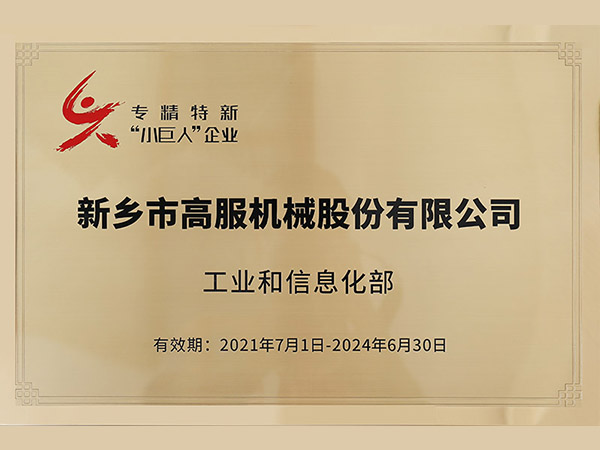
The predecessor of Xinxiang Gaofu Machinery Co., Ltd. was established in the 1980s. Over more than 40 years of development, the company has evolved into a "National-level Specialized, Refined, Differential, and Innovative (SRDI) 'Little Giant' Enterprise," a "National-level Green Factory," a "National-level High-tech Enterprise," and a "National-level Intellectual Property Advantage Enterprise," while also serving as the "Chairing Unit of the Vibration Association." It hosts the "Henan Industrial Design Center," the "Henan Intelligent Online Screening System Engineering Technology Research Center," and the "Xinxiang Precision Screening Engineering Technology Research Center." The company has successfully secured over 500 patents—covering inventions, utility models, and designs—received a "Science and Technology Achievement Award" from the Ministry of Industry and Information Technology, and participated in drafting four "National Standards."
Gaofu’s product portfolio spans multiple series and hundreds of varieties, including vibrating screening equipment, conveying equipment, coal crushing equipment, filtration equipment, and automated material handling systems. Key products cover vibrating screens, ultrasonic screens, linear screens, airflow screens, tumbler screens, roller screens, dewatering screens, and grizzly screens. They also include vacuum loaders, dust-free feeding stations, bulk bag stations, material supply systems, and automatic powder supply systems. Further products are slag-discharging filters, leaf filters, bleaching earth filters, toothed roll crushers, and coal crushers. These products serve food, pharmaceutical, chemical, metallurgical, mining, and environmental sectors. They have earned the trust of over 10,000 customers worldwide.
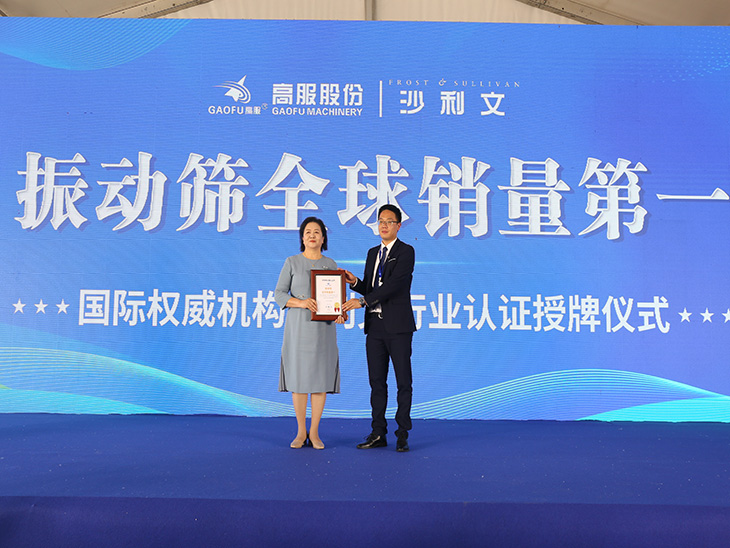
Gaofu products are trusted in Greater China and exported to over 100 countries. These include Russia, Canada, the USA, New Zealand, Japan, Brazil, and South Africa. Upholding the mission of "enhancing material quality and efficiency to meet customer needs," the company fosters harmonious, mutually beneficial partnerships with its clients. Gaofu supplies many Fortune Global 500 companies. These include CNPC, Sinopec, Sinochem, China Resources, Sinopharm, COFCO, CNBM, CASC, and Jinchuan Group. In May 2024, Frost & Sullivan issued a market position certificate. It recognized Gaofu as the global leader in vibrating screen sales by volume for 2023.